
Press Release
Finance Minister Engages Industrial Community on Policies Supporting Growth and Private Sector Confidence
Kouchouk emphasized that fiscal discipline cannot be sustained in the absence of a strong and diversified economy capable of achieving long-term growth.
The Minister of Finance, Ahmed Kouchouk, stated that current fiscal policies and ongoing tax and customs initiatives aim to strengthen cooperation with the private sector in support of economic activity and overall development outcomes.
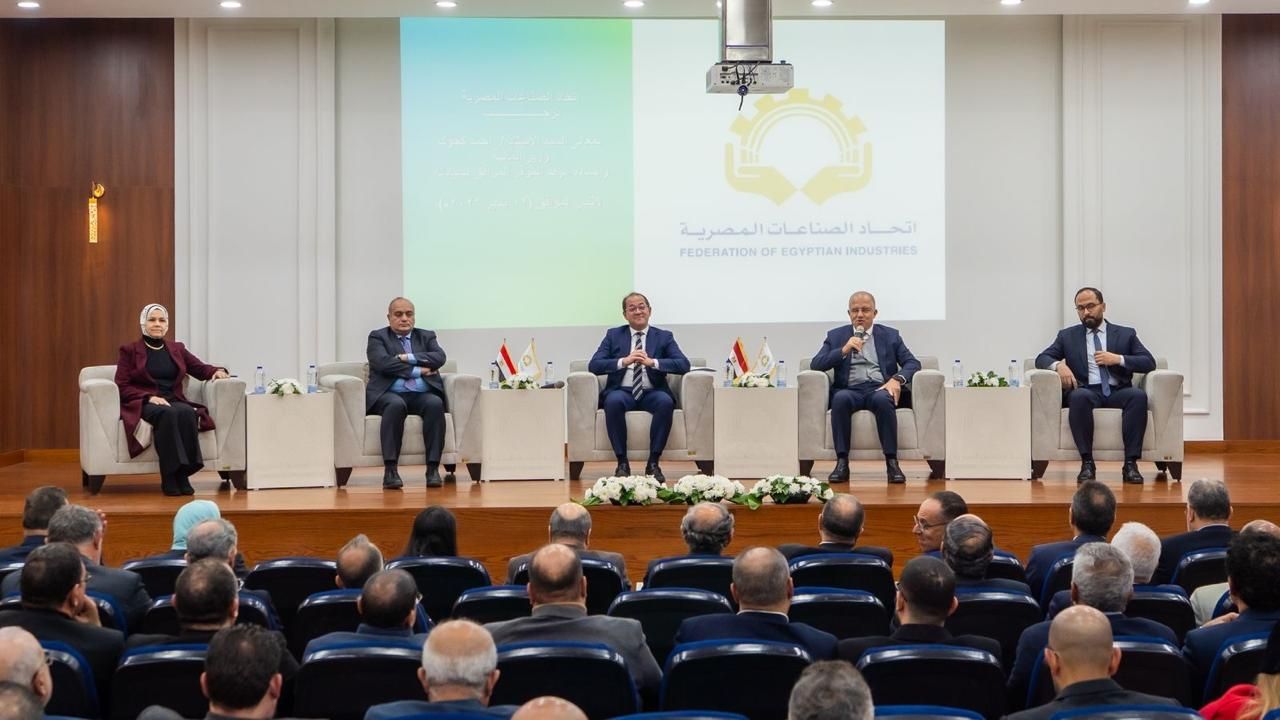
Speaking during an open dialogue with representatives of the industrial community at the Federation of Egyptian Industries, the Minister noted that ongoing discussions with stakeholders are contributing to the design of a tax reform framework intended to support production and export growth.
The Minister provided an overview of the first packages of tax facilitation measures results and the main pillars of the second package explaining their underlying rationale, key objectives, and the procedural changes they introduce.
These measures are intended to simplify the tax system, improve interactions with taxpayers, and strengthen trust and cooperation with the business community.
According to the Minister, policy priorities focus on advancing economic activity, expanding production and exports, and supporting the creation of adequate and decent employment opportunities.
He added that the government remains open to additional incentive mechanisms for industry and exports, with eligibility linked to demonstrated outcomes.
He noted that the first package of tax facilitation measures generated significant engagement from taxpayers and produced measurable results.
He further stated that the level of cooperation observed from the tax community underscores the importance of continuing reforms aimed at facilitation, simplification, and targeted incentives.
In this context, he indicated that a second package of tax facilitation measures includes the introduction of a simplified stamp duty to replace capital gains tax on stock exchange transactions for residents, alongside new measures to encourage the listing and trading of large companies on the Egyptian Stock Exchange.
He also referenced the introduction of a mobile application to facilitate notification and payment processes, and announced that a sample-based audit approach will be applied to electronic tax returns beginning in 2026.
He noted plans to establish specialized tax centers that will provide selected e-Tax services on behalf of the Egyptian Tax Authority.
He added that the simplified and integrated tax regime for small enterprises includes both tax and non-tax incentives, as well as access to low-cost financing for the first 100,000 taxpayers enrolled in the system.
According to the Minister, the private sector’s response to recent economic, fiscal, and tax reforms exceeded initial expectations.
Private investment increased by 73 percent in the previous year, while tax revenues grew by 35 percent without the introduction of additional tax burdens.
He underscored that improving public debt indicators remains a key policy objective in order to create additional fiscal space for investment in human development.
He noted that the debt-to-GDP ratio for budget entities declined from 96 percent to 84 percent over a two-year period, while external budget debt decreased by approximately USD 4 billion.
The Minister also stated that customs tariff structures will be reviewed to support industrial localization, ensure fair competition, promote the expansion of transit trade, and support the development of Egyptian ports as industrial and logistics hubs.
In related remarks, Mohamed El-Sewedy, Chairman of the Federation of Egyptian Industries, indicated that recent fiscal and tax reforms have begun to ease pressures on taxpayers and contribute to improved competitiveness.
He noted that economic indicators from the previous year were positive and expressed support for ongoing efforts to stimulate economic activity.
He added that measures aimed at supporting the industrial sector are expected to contribute to higher growth rates and the creation of sustainable employment opportunities.
The meeting featured extensive engagement from manufacturers and representatives of the industrial sector.
The Minister received a wide range of questions and interventions related to manufacturing challenges and issues facing producers, and engaged with participants through an open and constructive dialogue
 |
 |
 |
 |
- وزير المالية
Browse alsoMinister of Finance Speaks at the Egyptian African Businessmen’s Association and e-Tax conference
 Next article