
Finance Minister: Open to Political Forces; No “Silver Bullet” for Economic Challenges
The minister highlighted that the government is pursuing balanced fiscal policies aimed at stimulating economic activity while maintaining fiscal discipline and stability.
Ahmed Kouchouk, Egypt’s Minister of Finance, said the government remains open to engagement with political and national forces, noting that their proposals will be reflected in the country’s economic policy path. He stressed that there is “no single or magical decision” capable of resolving all challenges, underscoring the need for a comprehensive and integrated vision that clearly defines priorities and targets.
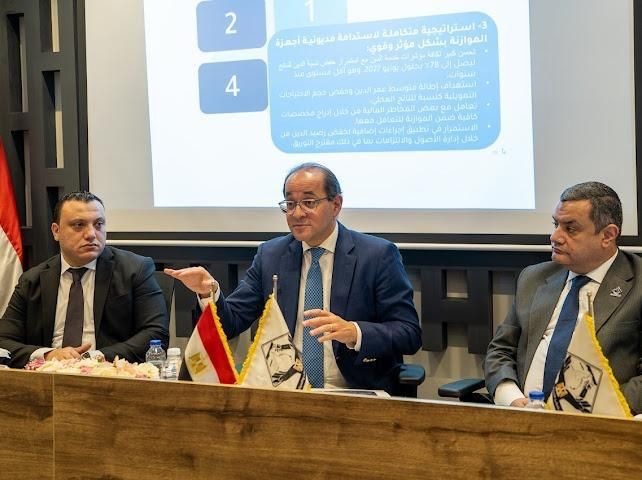
Speaking during an open dialogue with the Coordination of Youth Parties and Politicians, Kouchouk said Egypt draws on international experiences, but emphasized that policy choices must align with the country’s own conditions, capabilities, and development objectives. He added that improving fiscal indicators at the expense of economic contraction would not be acceptable.
He noted ongoing efforts to broaden the economic, productive, and tax base to strengthen state resources, stressing that “there can be no growth or development without a strong and competitive economy.”
Kouchouk said the government is rolling out packages of tax, real estate, and customs facilitation measures to reinforce a trust-based partnership with the business community.
He reaffirmed continued support for citizens and efforts to stimulate economic activity as much as possible despite current challenges, alongside a fiscal management framework designed to strongly support investment and exports.
He added that the new budget places a clear emphasis on human development and improving essential public services, with fiscal priorities translated into allocations, programs, and initiatives that have a more direct impact on people’s lives.
The minister revealed that EGP 48 billion has been allocated in the new budget to boost exports, with targeted programs supporting priority sectors.
He also noted significant opportunities for export growth in services, particularly outsourcing and information technology.
Kouchouk said the government is making substantial progress on its state offerings program, which is expected to witness a qualitative leap in the coming period.
He also pointed to continued support for the transition to solar energy to generate savings for both citizens and investors, with a strong increase in new and renewable energy capacity expected over the next two years.
He added that specialized tax service centers will be established to provide high-quality services to compliant taxpayers, noting that the simplified tax system represents a major incentive for entrepreneurs and small businesses to grow quickly and efficiently.
Low-cost financing will also be made available to the first 100,000 participants joining this simplified tax regime.
Kouchouk emphasized that the government aims to significantly improve public debt indicators to create greater fiscal space to support citizens and investors, adding that any exceptional revenues will be directed directly toward reducing overall debt.
The session was moderated by Akmal Nagaati, Member of Parliament representing the coordination body, and was attended by members of both the House of Representatives and the Senate, along with officials from the Ministry of Finance and revenue authorities.
 Next article