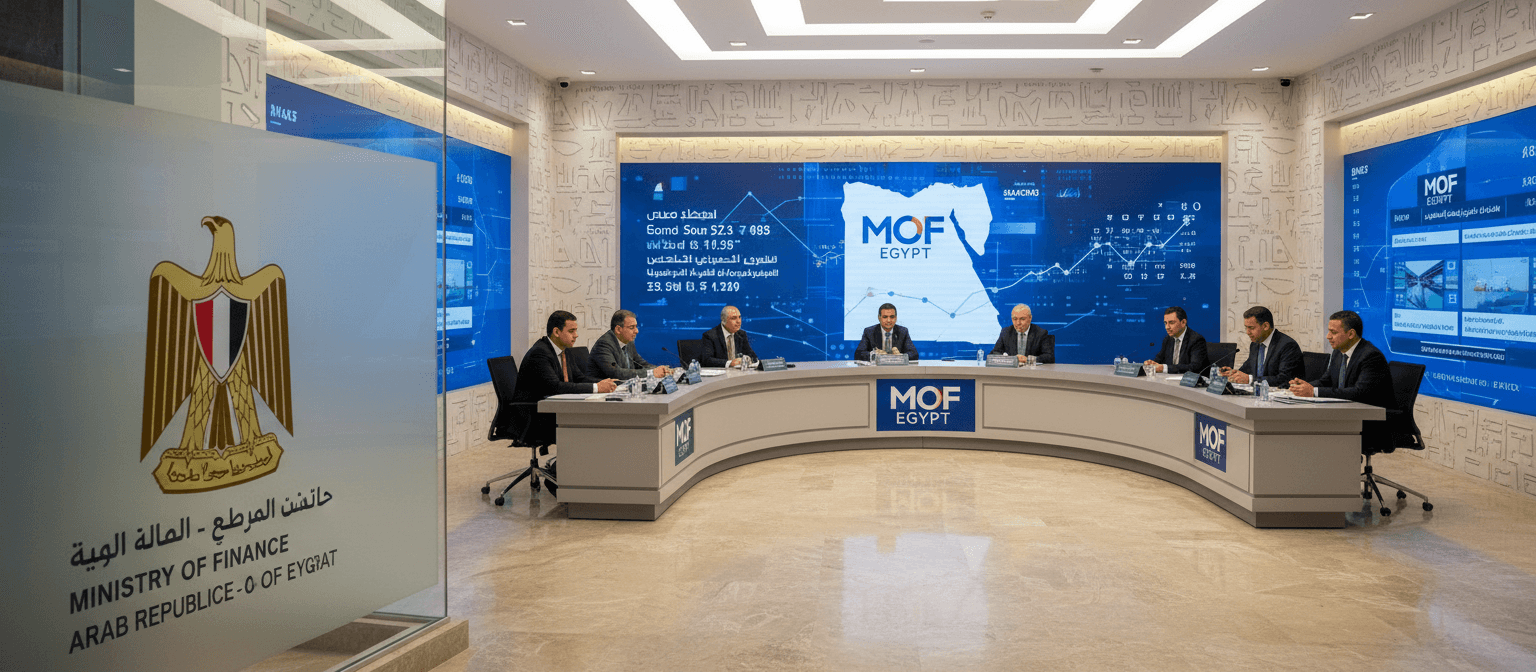

Meeting with chairmen of investment societies, Egyptian Finance Minister, Dr Samir Radwan
-
Forum for industrialists to meet periodically in the Ministry of Finance to follow up
developments of economic performance and solve problems of the production sector
Expansion plans continue and new investments to create more jobs
Alimentary industry sector working at full capacity to make available citizens’ needs of staple goods
Cabinet decrees on customs release of goods required for production against mere
written commitments and cancelling fines on tax sales delays are widely hailed
Egyptian Finance Minister Dr. Samir Radwan held a mass meeting on 19 Feb with chairpersons and representatives of investment societies in different governorates of Egypt. The meeting discussed the new economic developments and what these societies can do to revitalise the Egyptian economy and to create more job opportunities.
The meeting was the venue for the Ministry of Finance to launch a new initiative which is creating a forum for industrialists that will meet periodically with the Minister of Finance to discuss and follow up economic developments. The forum will take prompt decisions to solve the problems that may face the productive and exporting sectors in addition to following up the role of these sectors in creating new jobs.
Dr. Radwan said the forum was part of the government’s keen efforts to accomplish continuity of the productive sector, to restore the quick growth of the economy and to create more jobs especially for the young. A workgroup of a number of Egyptian industrialists has been set up with the purpose of following up the new developments and performance of the Egyptian economy since these industrialists follow closely the variables of the local and international markets.
The Egyptian Finance Minister has already met with several foreign ministers and ambassadors to Egypt who displayed readiness to provide all necessary aid and assistance to Egypt to help overcome the adverse economic impacts. He said their concern reflects Egypt’s status and role in the region.
Egyptian Federation of Investment Societies Chairman Mohammad Farid Khamis said the Egyptian industrialists support both the government and the people in facing the repercussions of the current events and that they would continue their plans to expand production capacities and set up new job-creating projects.
The first duty of the production sector in the current conditions, he added, is to help create new job opportunities, expressing investors’ optimistic outlook for a better future arising from the current changes which are conducive to investment and production.
Discussed in the meeting as well was the possibility of setting up tax mechanisms that cater for the needs of the different requirements of the tax community and lead to ameliorating the taxation systems.
Mr. Khamis revealed efforts exerted
by Egyptian industrialists to protect Egypt’s foreign markets through several visits to these markets and Egypt’s partners and customers abroad to explain the new development in the country and to show the sure ability of the Egyptian industrial sector to honour its commitments towards them. In one of the meetings, an important Gulf investor asserted that as soon as normalcy is restored, most Gulf investments will be directed to the Egyptian market, anticipating that Egypt will be like Malaysia within the next five years.
Sixth of October Investors’ Society Chairman Safwan Thabet hailed Ahmed Shafiq government’s decisions concerning customs release of production requirement goods against mere written commitments to pay taxes and customs dues when normalcy is restored, and cancelling fines on delayed payments of social security subscriptions and sales taxes for January and February. These measures relieved many of the burdens of the production sector.
Mr Thabet expects that the government decree of a 15% raise for government and public sector retired and current employees, in addition to the private sector's commitment to such a raise, will contribute to creating demand and boom in the market, which in turn will create more job opportunities.
To secure more liquidity for the production sector, he suggests delaying tax payments for industrial and trading establishments from 30 March to 30 June, which can lead to a flourishing local demand in the market.
The production sector is concerned that banks may expand loan granting to the government at the expense of the loans given to this sector. Accordingly, he asks the government to interfere with banks to make available more loans to finance expansions in both the industrial and trade sectors.
The alimentary industries sector, he adds, has been working at full capacity, even through the first days of the recent events, which contributed to avoiding any adverse fluctuations in the food market in Egypt. The relevant companies and Egyptian workers bear this onerous burden. Mr. Thabet mentioned as well that the Sixth of October City has managed well the problems it faced in the recent events.
Sadat City Investors Society Chairman Dr. Sherif Al-Gebali said Egypt needs private sector investments estimated in billions of Egyptian pounds annually in order to provide 750 thousand citizens with jobs, suggesting obligating private corporations and establishments to finance public projects to serve their local communities. Suggested projects are such as road paving, hospitals, and schools for the underprivileged neighbourhoods.
Al-Gebali raised the issues facing the production sector such as suppliers of production requirements cancelling the 120-day grace period for payment of the price of consignments shipped. They currently demand paying in advance for the contracted transactions or presenting letters of credit or bank guarantees, which aggravates the burdens shouldered by the industrial sector.
Moreover, Tenth of Ramadan Investors Society Chairman Moharam Hilal emphasised both the industrial sector’s support for the government and the necessity for extending bridges of trust between the government and the people in order to overcome the current crisis.
Al-Obour City Investors Society Chairman Mohammed Al-Morshedi, in his turn, expressed the understanding of the industrial sector of the gravity of the current conditions. Some industrial entrepreneurs are apprehensive about the possible strikes and labour demands; they see that security issues should have government priority to ensure the continuity of industrial activities.
Al-Morshedi further articulated the ability of the industrial and investment sectors to create job opportunities through many measures and decisions that need to be revised. Such measures include the Egyptian social security system with the high rates paid by the employers who find themselves forced to lower the sums of social security subscription not reflecting real set wages. He suggested revising the rates to a mere 15% of the wages and raising the ceiling of salary tax exemption to cater for family needs.
Other suggestions include revising the system of Exports Aid Fund to turn the subsidies granted to the exports into mere value added subsidies to help more local industries.
Sales tax on capital goods should be cancelled, he further suggested, instead of the reimbursement system used currently which is the cause behind several law suits in courts today.
Sohag Governorate Investors Society Chairman Mohammed Al-Shandaweeli said Upper Egypt governorates have 25 industrial zones, 15 of which have already been provided with utilities, costing the Industrial Zones Utilities Fund around L.E. 850 million. He demanded accelerating the utilities programs for the rest of the industrial zones which will make available between 30 thousand and 40 thousand jobs.
Furthermore, he emphasised the need for speeding up the plans of setting up furniture industrial zones in Sohag following the Damietta example. Such projects, which will include around 2000 workshops, can provide between 15 thousand and 20 thousand new job opportunities.
Beni Sweif Governorate Investors Society Chairman Mohsen Al-Gebali explained that the small and medium-size projects represent more than 95% of the total projects in the Upper Egypt governorates. However, they face problems in obtaining bank financing especially after establishing a firm for reviewing bank customers’ credit feasibility, which declines many credit applications for bureaucratic reasons.
Investors Federation Executive Committee for Tourism and Taxation Chairman Tareq Hanafi complained that large investment projects in Taba and Noweiba are currently not functioning because of financing problems. These investments can provide jobs for five thousand workers. He further expressed concern over the numerous problems plaguing the touristic sector, such as the unrealistic prices where the hotel room night costs USD 20 in Egypt, compared to USD 100 in Turkey, which is attributed to the hegemony of international corporations on the market after buying many of the large hotels.
Scientific Centre Chairman Dr Hammad Abdallah suggested imposing investment fees for developing the infrastructure, in the spirit of achieving social justice, as a temporary alternative for the progressive tax that needs legislation which is not possible currently.
The problem of unavailability of lands for industrial projects, creating a snag in the way of expansion and pumping new investments, was raised by the Egyptian Federation of the Investors’ Societies Secretary General, Dr. Adel Rahoma.
The Ministry of Finance should find another method of covering the general budget deficit other than treasury bonds & bills, and subsidising exports should be linked to the added value, suggested General Federation of Invertors, Moetassem Rashed.
Moreover, the recent period has witnessed chaotic pricing of the different products, which necessitates state intervention to ensure social equality, added Mr Rashed.
In response to these demands and suggestions, Dr Radwan stressed that all raised issues will be studied, asserting that he is keen on solving the problems facing the industrial sector. As for the progressive taxes, he mentioned that many international studies show that no one pays such high taxes. The suggestion of imposing fees for developing the infrastructure is, however, a gesture that gives a positive image of the businessmen.
(Source: Ministry of Finance)
 Next article